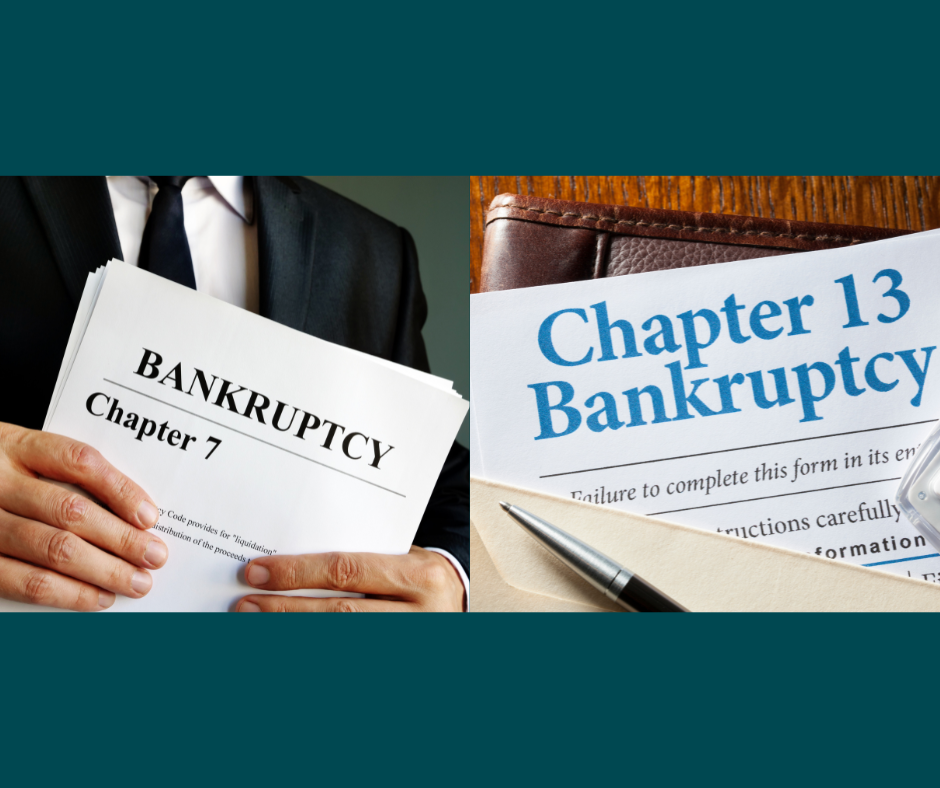
WHAT IS THE DIFFERENCE BETWEEN A CHAPTER 7 AND CHAPTER 13 BANKRUPTCY?
Consumers facing the decision to file bankruptcy have several choices to make. Should I file? If so, which chapter should I file under? What are the implications? Can I ever dig out from the impact it will make on my credit rating? Each of these considerations are important since consequences may go along with each decision.
The Bankruptcy Code is a federal law meant to give a fresh start to filers but is also meant to treat each creditor fairly. Filers have a choice between filing under chapter 7 (assets, if any, are sold and the proceeds paid to creditors); chapter 9 (municipalities only); chapter 11 (primarily businesses but also individuals with significant debt); chapter 12 (family farmers and fisherman); chapter 13 (a payment plan is proposed to pay creditors such as mortgage arrears, tax liabilities, and vehicle loans); or chapter 15 (international bankruptcies only). However, in most cases, individuals with primarily consumer debt, like mortgages, car loans, credit cards and personal loans, file either under chapter 7 or chapter 13 of the Bankruptcy Code.
Chapter 7 is the easiest chapter to file under. Within a few months after filing the bankruptcy petition with the supporting schedules and documents, you are hopefully granted a full discharge, or legal forgiveness, of your debts. There are exceptions, such as tax debt, support payments to family members, and fraudulent debts, but for the most part you get a fresh start from your former debts. You are thereafter given an opportunity to use credit wisely and gradually increase your ability to obtain good credit and keep it that way.
But the Bankruptcy Code limits who can file under chapter 7. If you make too much household income, the filing of a chapter 7 may be considered to be an abuse of the system and your case may be dismissed. Most filers must complete the Means Test in which your income and family size are compared to the income of others with the same family size. If your household income exceeds the median income for your state, you must either show that your disposable income does not justify filing under chapter 13 or that you have “special circumstances” which generally are outside your control with limited options to avoid the circumstances. Otherwise, the court may dismiss your case, or you must agree to use those extra funds in a chapter 13 filing.
More importantly, if your property’s value exceeds certain limits, the trustee in the chapter 7 can put your property up for sale and use the proceeds to pay your creditors. You must list all of your property with a good faith valuation of each asset. You can also subtract any liens, such as mortgages and vehicle loans, against the property. You then apply exemptions, which are determined under the Bankruptcy Code and vary from state to state, to remove a certain amount of value from the bankruptcy. If no value is left, you keep the property. If value remains, it becomes available to the chapter 7 trustee for liquidation. Once you file under chapter 7, you cannot change your mind and dismiss the bankruptcy altogether. So, the filing of a chapter 7 bankruptcy without considering all of the ramifications may spell disaster.
If you are caught in a chapter 7 when you realize that you may lose some property, you have the option to convert your case to a chapter 13 filing. You may also start under chapter 13 if it is the best interest for your situation. Under chapter 13, you commit your disposable income rather than your assets to pay creditors. The Means Test mentioned above in most cases determines how much you must pay into a pot for your creditors. Chapter 13 plans generally last anywhere from three to five years.
A second determining factor in drafting a chapter 13 plan is the amount of non-exempt equity you have in certain property. As explained previously, you can protect equity in asserts by trading them for disposable income. Thus, if you have $50,000 in non-exempt equity in your home, you can pay $50,0000 into a chapter 13 plan to your creditors. You keep the house, and the creditors get the equity they otherwise would be entitled to.
The third, and often most important, factor in filing under chapter 13 is to pay debts to preserve your assets. For instance, if you are facing a foreclosure of your home, you can file under chapter 13 and pay the accumulated arrears and costs through a plan over a period of time not to exceed five years. You will also continue to pay your mortgage during the plan term so that when you finish the plan, you are current with the mortgage. You can do the same with car payments, taxes, support and other debt that is backed by your property. Just about any debt can be dealt with through a chapter 13 except student loan debt. Unless you can prove that you are incapable of paying the student loan and that this condition will remain for a significant period of time, there is not much that can be done at this point with such debt. However, the bankruptcy will relieve you of certain debts that may make such payments easier to make.
The Bankruptcy Code is full of traps to catch the unwary. It is always best to seek professional help before making your final decision to avoid any unpleasant surprises that may cause more problems than you face now. Thus, the Law of Holes: If you are in a hole, stop digging. At https://www.cgalaw.com/practice-areas/bankruptcy-debt-restructuring/, we literally have decades of experience helping clients navigate the deep waters of bankruptcy. It is a tool that should be used only with the assistance of an attorney who has been there. We can even help you to reestablish your credit once you are finished. One firm, all the law you need℠.